
Wellness AF Club · Library · Goes with Lesson 16
Does it matter if your produce is organic?
Lesson 16 was blunt: just eat them, dammit. The second you actually commit to that, a new worry shows up at the grocery store. Do they have to be organic? Is organic worth it, or is that just clever marketing? Here’s the honest answer, the real science behind it, and what matters more than the little green label.
So you’ve decided to eat your five a day. Good. It’s one of the best things you can do for your health. Which leaves one nagging question at the store: is organic worth it?
Now you get to the produce aisle, and the conventional strawberries are $3, and the organic ones are $6, and a voice in your head says the cheap ones are basically poison. That voice is repeating a decade of marketing. The research will help calm that voice. Here’s what the studies actually found, because the truth is more useful (and more freeing) than the fear.
Quick promise before we start: nothing here is going to tell you to spend more money. The whole point of Lesson 16 stands no matter what you buy: EAT FRUITS AND VEGGIES!
What “organic” even means
Organic is a regulated legal standard with associated audits. In the US, the USDA Organic seal means the crop was grown without synthetic pesticides, synthetic fertilizers, sewage sludge, or genetic engineering, and the farm got audited to prove it.
This is where it trips people up. Organic does not mean pesticide-free. Organic farmers absolutely use pesticides, they just use ones approved for organic systems (often plant- or mineral-derived). “Natural” pesticide and “no pesticide” are not the same thing, and a few organic-approved ones are no gentler than the synthetic versions.
So here’s the big question: are the differences that do exist big enough to matter for your body and your budget? Let’s find out.
Is organic actually more nutritious?
This is the claim that sells the $6 strawberries, so let’s test it.
Two of the largest reviews ever done showed the same thing. A 2009 systematic review in the American Journal of Clinical Nutrition pooled data from 162 studies and found no meaningful differences in nutrient content between organic and conventional foods1. A 2012 Stanford review in the Annals of Internal Medicine pooled 223 studies and found that the evidence doesn’t show organic foods are more nutritious2.
The vitamin C, the potassium, the fiber, the folate, all the stuff that makes produce a powerhouse, comes through about the same whether the carrot was grown organically or not.
There’s one interesting wrinkle in those, though. A 2014 meta-analysis of 343 studies in the British Journal of Nutrition found that organic crops have higher levels of a class of plant compounds called polyphenols3.
In that analysis, organic crops had higher levels of several polyphenol families, from about 19% more phenolic acids to nearly 69% more of a group called flavanones, and they had lower levels of cadmium, a toxic metal that accumulates in the body over time3.
Worth knowing. But hold your applause, because “more antioxidants measured in the food” and “more antioxidants doing something in you” are two very different things. We will get to more of this in a minute.
The pesticide question, where organic actually wins
This is the real, measurable difference.
Conventional produce is roughly four times more likely to carry detectable pesticide residues than organic3. The Stanford review put the same finding in a different way: the risk of a sample carrying detectable residue was about 30% lower for organic2.
And it shows up in your body, fast. When researchers took families eating a conventional diet and simply switched them to an organic diet, pesticide breakdown products in their urine dropped within days. One study of US adults and kids saw a malathion marker fall about 95% and a chlorpyrifos marker fall about 61% after the swap4. An earlier study put children on organic food for five days and watched two common pesticide markers drop to nearly undetectable5.
So if your goal is to lower pesticide exposure, organic clearly does that. Real effect, measured in real people.
Now the honest caveat, because I’m not going to fearmonger you into the expensive aisle. The residues found on conventional produce are almost always well below the safety limits set by regulators2. “Detectable” means the instruments are sensitive, not that the amount is dangerous. Lower exposure is a reasonable thing to want. It just isn’t the same as proven harm from the conventional stuff.
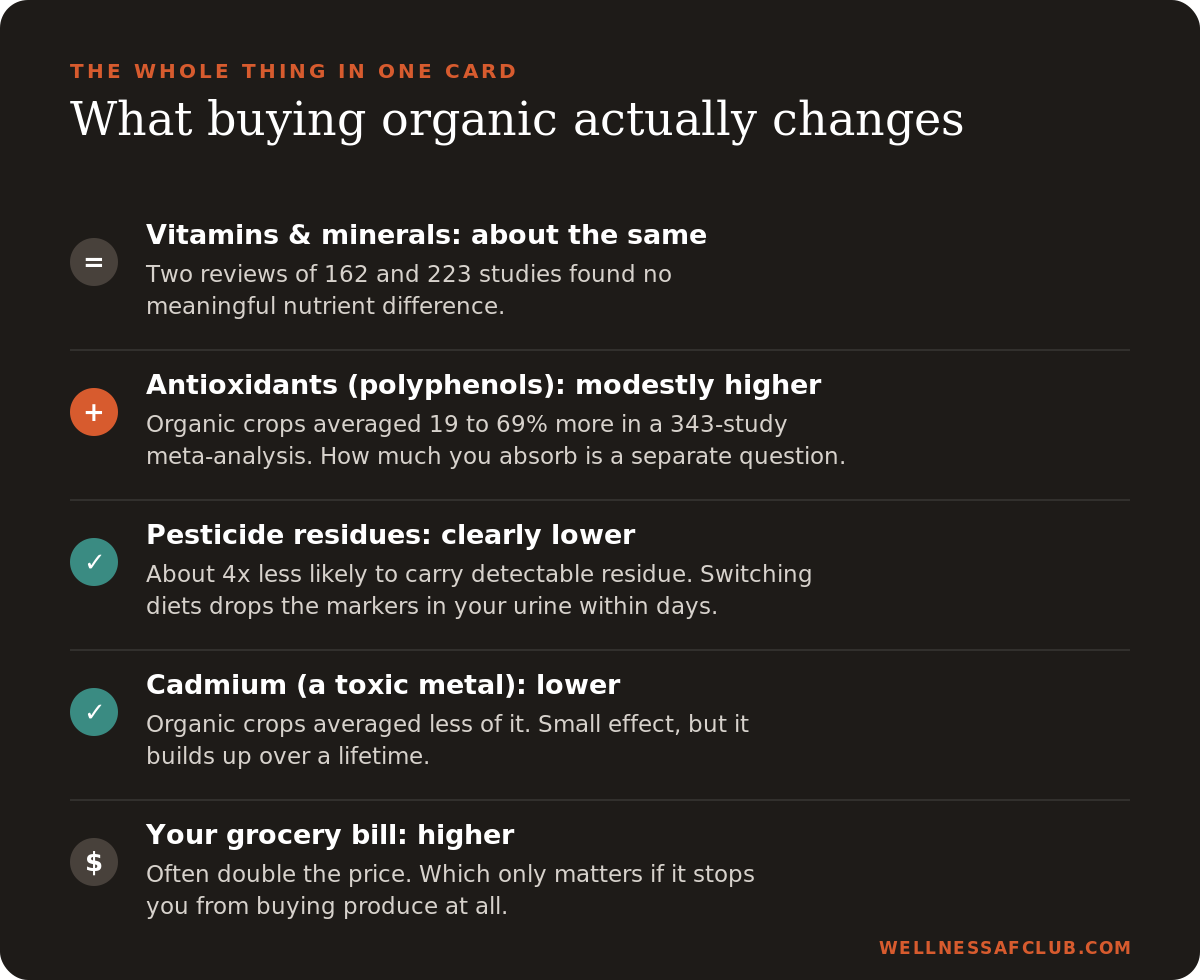
What buying organic actually changes, at a glance.
But does eating organic make you healthier?
This is the question that actually matters, and it’s where the marketing gets quiet.
Two large studies followed huge groups of people for years and came to opposite conclusions. A French study of nearly 69,000 adults found the people who ate the most organic food had about 25% lower cancer risk over the follow-up6. Encouraging. But a British study of 623,000 women found no drop in overall cancer for organic eaters at all, with a possible exception for one type of lymphoma7.
When two big studies disagree this hard, it usually means the honest answer is “we don’t know yet.” Both are observational, which means they watched people’s choices instead of assigning diets. And people who buy lots of organic food tend to also exercise more, smoke less, and eat more produce overall. Untangling the organic label from the healthy-person bundle around it is really hard.
The newest research backs that up without settling it. Two big systematic reviews came out in 2024, the most current ones we have. One found that across the long-term studies, eating organic lined up with lower rates of cardiometabolic trouble like obesity, diabetes, high blood pressure, and high cholesterol, alongside the usual drop in pesticide exposure8. The other pooled 50 studies and reached the same split as everything before it: a clear win on pesticide exposure, a thumbs-up for the polyphenols, and still no verdict on cancer or basic nutrition9.
Read that cardiometabolic signal with the same caution as before. The people buying the most organic are also the ones eating more produce and moving more, so the label keeps getting credit the lifestyle may have earned. (One of those 2024 reviews had authors from a dairy company, so it isn’t a neutral referee either.)
So I’m not going to tell you organic is a proven health upgrade. The strong, repeated, can’t-miss-it evidence is for eating produce at all, organic or not. That’s the finding behind Lesson 16, and it dwarfs anything the organic label adds on top.
The word that matters more than “organic”: bioavailability
Okay. Here’s a concept I want you to get because it can work in other areas where companies are trying to sell you the benefit of a supplement.
This is where the “organic has more polyphenols” thing comes back down to earth. Those antioxidants are notoriously hard to absorb. A review of 97 human studies found polyphenol absorption ranges from under 1% to about 43% of what you eat, depending on the specific compound10. And the polyphenols you eat the most of often aren’t the ones your body absorbs best11.
Translation: a modest bump in polyphenol content from buying organic can easily get swallowed by how little of it you absorb in the first place. The label gives you a slightly richer raw material. Your body decides how much actually counts.
So what does move the needle on absorption? How you prepare and pair your food. And the effects here are not small.
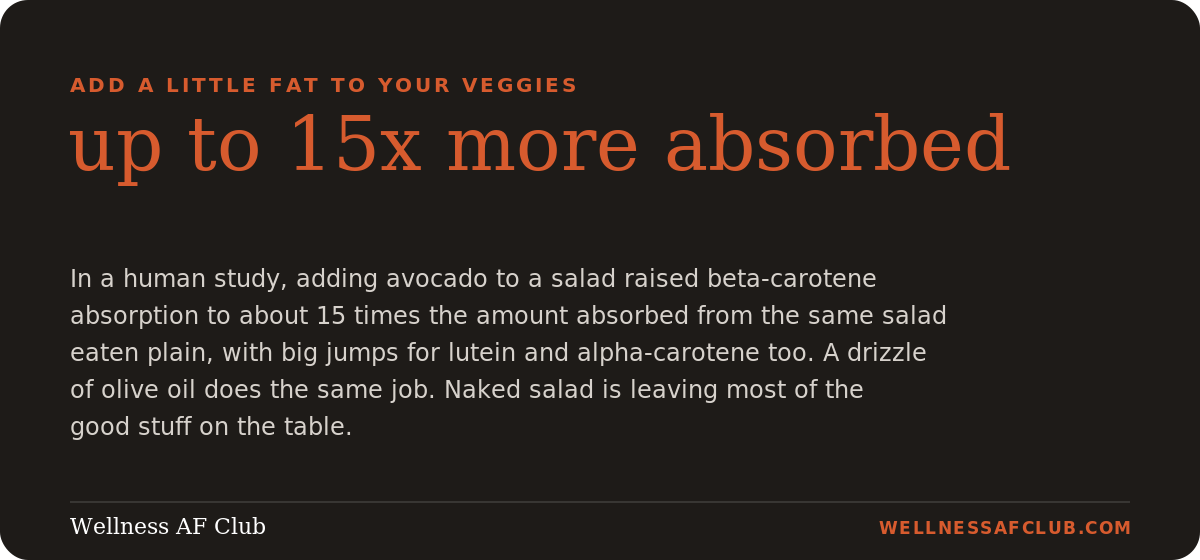
Adding avocado or its oil to salad raised carotenoid absorption up to 15-fold in a controlled human study.12
The reason is simple plumbing. Pigment antioxidants like beta-carotene and lycopene are fat-soluble, so they need a little dietary fat riding along to get ferried across your gut wall. No fat means poor pickup.
Cooking helps, too, for certain foods. When researchers fed people cooked versus raw cherry tomatoes, the cooked version raised blood levels of two tomato antioxidants that the raw version didn’t budge13. Heat breaks down tough plant cell walls and frees the compounds trapped inside. Your grandmother’s slow-simmered tomato sauce was quietly doing nutrition science.
Sit with the size of this for a second. Buying organic might get you maybe 20 to 50% more of certain antioxidants in the raw food. Adding a spoon of olive oil or roasting your vegetables can multiply how much you absorb several times over. The prep beats the label, and it’s basically free.
Organic, the honest pros and cons
No spin. Here’s the whole ledger.
In favor
- Fewer pesticide residues, and measurably lower pesticide markers in your body within days.
- Lower cadmium, a toxic metal that accumulates slowly over a lifetime.
- Modestly higher antioxidant content on average.
- Organic meat carries fewer antibiotic-resistant bacteria, a real public-health plus.
- Often better for soil and farmworkers, if that is a value of yours.
Against
- Costs more, sometimes double.
- No proven advantage in vitamins or minerals.
- No settled proof it makes you healthier long-term.
- “Organic” does not mean pesticide-free, so the mental halo is bigger than the effect.
- Spoils faster, so more of it can end up in the trash.
- The worst case: the price tag talks you out of buying produce at all.
So, is organic worth it? Here’s what I’d do
Here’s how I’d play it, in order of how much each move is backed by evidence.
- Eat the five servings. Organic or not. This is the only step with overwhelming, repeated evidence behind it, the kind Lesson 16 walked you through, roughly a third lower risk of dying early14. Conventional broccoli you’ll actually eat beats organic broccoli you skipped because it was pricey.
- Add fat and cook for variety. Free, and it can multiply what you absorb. Olive oil on the salad, avocado on the toast, tomatoes into the sauce. This step might do more for your actual nutrition than the organic label ever will.
- Wash everything. A good rinse and rub under running water removes a chunk of surface residue and dirt from any produce, including organic. Free, fast, worth doing.
- If you have the budget and want lower exposure, prioritize organic for the stuff you eat skin and all. Berries, leafy greens, apples, grapes. You’re eating the surface, so residues have nowhere to hide. For thick-skinned things you peel, like bananas, avocados, and onions, conventional is an easy call. Spend the organic money where it does the most.
That’s the whole strategy, and it answers the question. Is organic worth it? As a nice-to-have, yes, sitting near the top of a pile of things that matter more. The flag Lesson 16 planted still stands: more produce, however you can get it onto your plate, is the win. Don’t let a $6 clamshell of strawberries make you forget that a $3 one is still one of the best things you’ll eat all week.
Like this? It’s how I do every topic.
Evidence first, hype never. Get the next one in your inbox.
Join the ClubSources
Drawn from peer-reviewed research indexed on PubMed. Every figure above traces to one of these:
- Dangour AD, et al. Nutritional quality of organic foods: a systematic review. Am J Clin Nutr. 2009. doi:10.3945/ajcn.2009.28041
- Smith-Spangler C, et al. Are organic foods safer or healthier than conventional alternatives? A systematic review. Ann Intern Med. 2012. doi:10.7326/0003-4819-157-5-201209040-00007
- Baranski M, et al. Higher antioxidant and lower cadmium concentrations and lower incidence of pesticide residues in organically grown crops. Br J Nutr. 2014. doi:10.1017/S0007114514001366
- Hyland C, et al. Organic diet intervention significantly reduces urinary pesticide levels in U.S. children and adults. Environ Res. 2019. doi:10.1016/j.envres.2019.01.024
- Lu C, et al. Dietary intake and its contribution to longitudinal organophosphorus pesticide exposure in urban/suburban children. Environ Health Perspect. 2008. doi:10.1289/ehp.10912
- Baudry J, et al. Association of frequency of organic food consumption with cancer risk: the NutriNet-Santé cohort. JAMA Intern Med. 2018. doi:10.1001/jamainternmed.2018.4357
- Bradbury KE, et al. Organic food consumption and the incidence of cancer in a large prospective study of women in the UK. Br J Cancer. 2014. doi:10.1038/bjc.2014.148
- Poulia KA, et al. Impact of organic foods on chronic diseases and health perception: a systematic review of the evidence. Eur J Clin Nutr. 2024. doi:10.1038/s41430-024-01505-w
- Jiang B, et al. The effects of organic food on human health: a systematic review and meta-analysis of population-based studies. Nutr Rev. 2024. doi:10.1093/nutrit/nuad124
- Manach C, et al. Bioavailability and bioefficacy of polyphenols in humans. I. Review of 97 bioavailability studies. Am J Clin Nutr. 2005. doi:10.1093/ajcn/81.1.230S
- Manach C, et al. Polyphenols: food sources and bioavailability. Am J Clin Nutr. 2004. doi:10.1093/ajcn/79.5.727
- Unlu NZ, et al. Carotenoid absorption from salad and salsa by humans is enhanced by the addition of avocado or avocado oil. J Nutr. 2005. doi:10.1093/jn/135.3.431
- Bugianesi R, et al. Effect of domestic cooking on human bioavailability of naringenin, chlorogenic acid, lycopene and beta-carotene in cherry tomatoes. Eur J Nutr. 2004. doi:10.1007/s00394-004-0483-1
- Aune D, et al. Fruit and vegetable intake and the risk of cardiovascular disease, total cancer and all-cause mortality. Int J Epidemiol. 2017. doi:10.1093/ije/dyw319
Free weekly newsletter
Get the research in your inbox
One email a week, real science about women’s health, explained in plain English.