
TL;DR
- Fat loss is a calorie deficit. Biology makes a deficit hard to hold.
- Your body adapts as you lose, so a sustainable deficit beats an aggressive one.
- People underestimate what they eat by a lot. Honest tracking fixes that.
- Protein and everyday movement (NEAT) protect your muscle and your results.
If you’ve ever struggled to figure out how to lose weight and keep it off, I want to start by telling you something important: your body is not working against you. It’s doing exactly what it’s designed to do. Your body is doing exactly what it’s built to do. The real gap is almost always that you don’t have the right information, or the right framework, to work with how your biology actually operates.
That’s what this episode (and this post) is about. I’m giving you the full system: how your body actually burns energy, how to figure out the right calorie target for you, how to set up your macros, and how to track your progress without losing your mind. Let’s get into it.
Free download
The Fat Loss Starting Kit
The whole framework on two pages: the deficit math, your protein target, the checklist, and the studies behind it. Built to keep.
Get the PDF plus a weekly, science-backed email. Leave anytime.
Why body fat actually matters (beyond how you look)
Before we talk about losing weight, let’s talk about why excess body fat is a health issue, not a character flaw. This is physiology.
When fat cells expand beyond their capacity, they start running low on oxygen. When that happens, some of those cells die, and your immune system shows up to clean up the mess. That immune response creates chronic, low-grade inflammation throughout your body. This isn’t the kind of inflammation you can feel, like a swollen ankle. It’s systemic, silent, and it’s connected to cardiovascular strain, metabolic dysfunction, joint stress, and respiratory issues.
Here’s the encouraging part: research consistently shows that even a 5% loss of body weight, sometimes even 3%, produces meaningful clinical improvements. For a 200-pound person, that’s just 10 pounds. You don’t have to lose 50 pounds to start getting healthier. You just have to start.
Your metabolism isn’t broken (seriously)
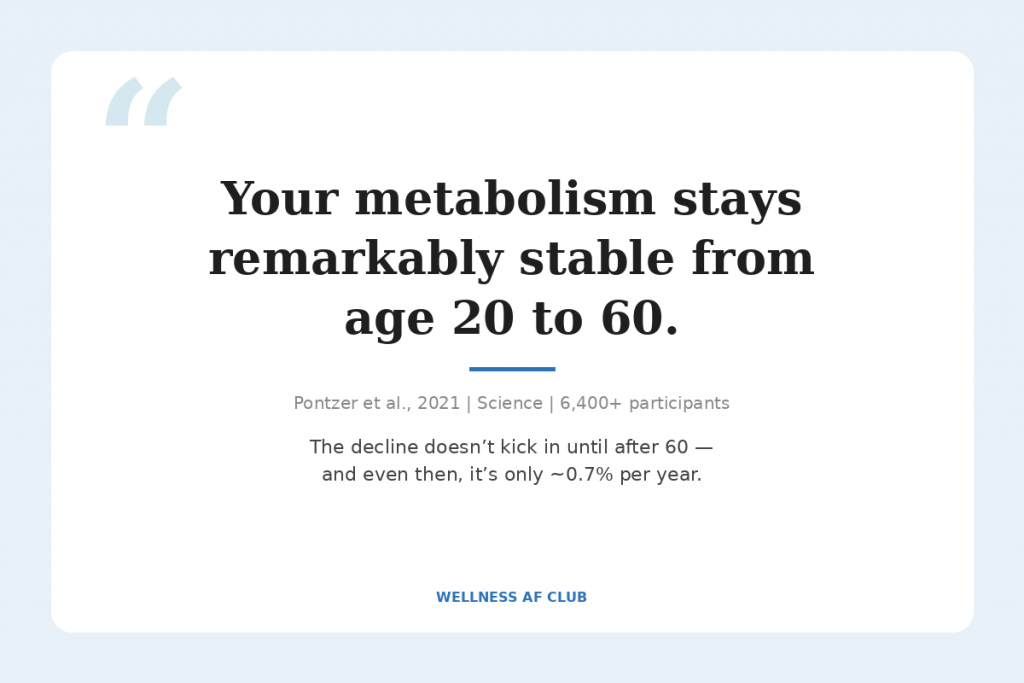
One of the most persistent myths out there is that your metabolism tanks after 30 or 40. A landmark 2021 study by Pontzer and colleagues, published in Science, analyzed data from over 6,400 people and found that total daily energy expenditure stays remarkably stable from roughly age 20 to 60. The decline doesn’t really kick in until after 60, and even then, it’s only about 0.7% per year.
So why does it feel harder to stay lean as you get older? Two reasons. First, body composition shifts: as estrogen declines (especially heading into perimenopause), your body tends to store more fat centrally and you gradually lose muscle mass if you’re not strength training. Second, less muscle means a slightly lower basal metabolic rate, roughly 50 to 100 fewer calories burned per day. That’s real, but it’s not the metabolic catastrophe the internet makes it sound like.
How your body burns calories: understanding TDEE
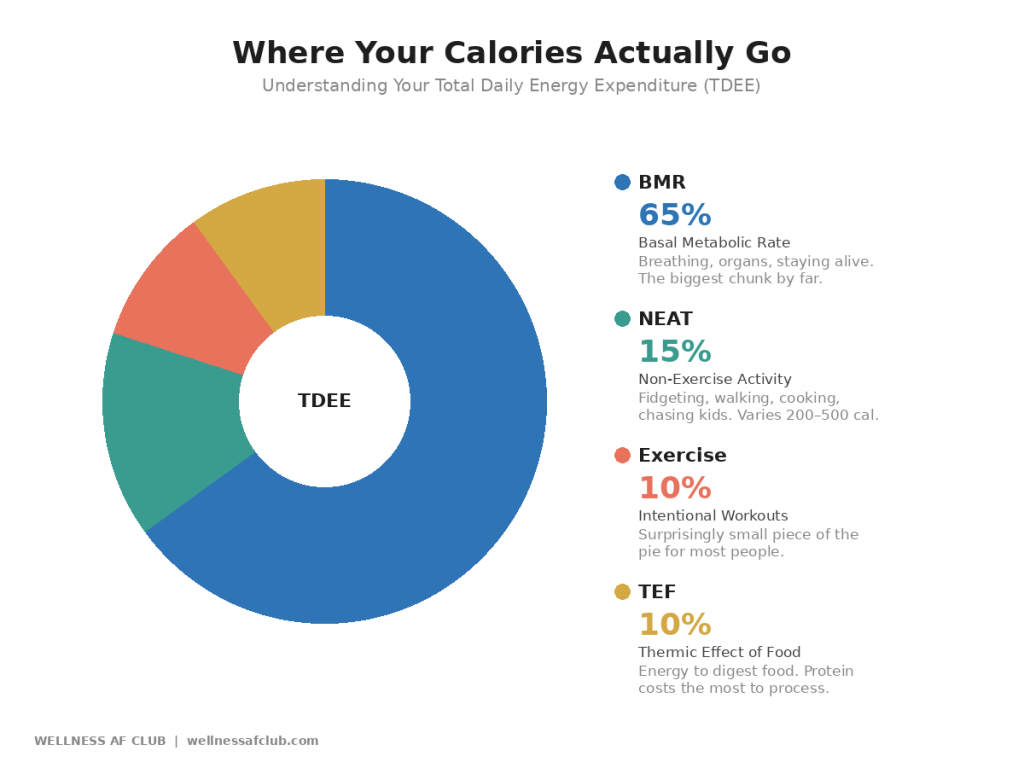
Your Total Daily Energy Expenditure (TDEE) is made up of four components:
- Basal Metabolic Rate (BMR) , the calories your body burns just existing. Breathing, circulating blood, keeping your organs running. This is the biggest chunk, usually 60–70% of your total.
- Non-Exercise Activity Thermogenesis (NEAT) , everything you do that isn’t intentional exercise. Fidgeting, walking to your car, cooking dinner, chasing your kids. This can vary by 200 to 500 calories between people.
- Exercise , your intentional workouts. This is actually a relatively small piece of the pie for most people.
- Thermic Effect of Food (TEF) , the energy it takes to digest what you eat. Protein costs the most to digest, which is one reason higher protein diets are so effective.
To estimate your BMR, the Mifflin-St Jeor equation is the gold standard. Then you multiply by an activity factor (most people are “lightly active,” which is a multiplier of 1.375) to get your TDEE. I’ve pinned the formula in the show notes, or you can skip the math entirely and use the free calculator in the Wellness AF app.
→ Next: Setting your calorie target, your personal math, and the macro breakdown that makes it all sustainable.
Setting your deficit: how much to eat
Once you know your TDEE, weight loss comes down to eating less than that number consistently. Here’s the general framework:
- 250-calorie daily deficit → roughly half a pound per week
- 500-calorie daily deficit → roughly one pound per week
- 750-calorie daily deficit → roughly one and a half pounds per week
The recommended rate of loss is 0.5–1% of your body weight per week. Go faster than that and you risk losing more muscle, feeling terrible, and watching your body subconsciously dial down your NEAT to compensate (this is real, your body literally makes you move less without you noticing). Fast loss chips away at your bones, too. Here’s what dieting does to bone density and how to protect yours.
A classic approximation: one pound of body fat is roughly 3,500 calories. It’s not perfectly precise, but it’s a useful planning tool.
Putting it together: meet Susie
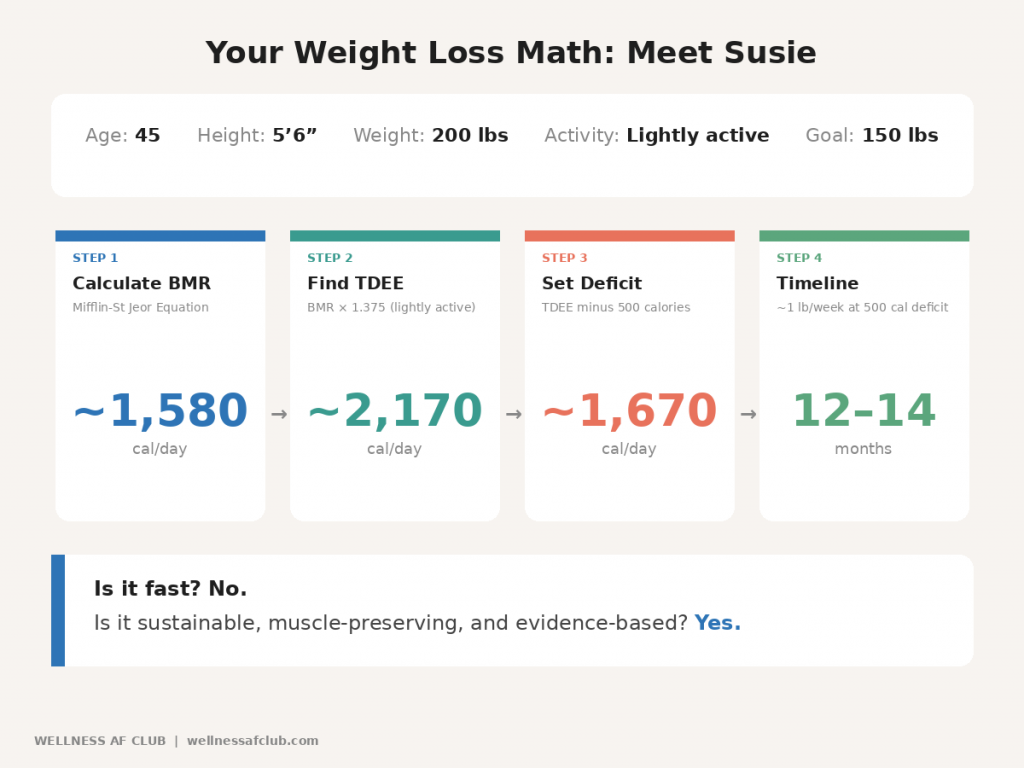
In the episode, I walk through a full example with a hypothetical woman named Susie: she’s 45, 5’6”, 200 pounds, lightly active, with a goal weight of 150. Here’s her math:
- BMR (Mifflin-St Jeor): approximately 1,580 calories
- TDEE (BMR × 1.375): approximately 2,170 calories
- Deficit target (500 cal/day): approximately 1,670 calories
- Estimated timeline to goal: 12–14 months
It’s not fast. But it’s sustainable, it protects muscle, and the science backs it. That’s the point.
Free download
The Fat Loss Starting Kit
The whole framework on two pages: the deficit math, your protein target, the checklist, and the studies behind it. Built to keep.
Get the PDF plus a weekly, science-backed email. Leave anytime.
Macros: what to eat (the simple version)
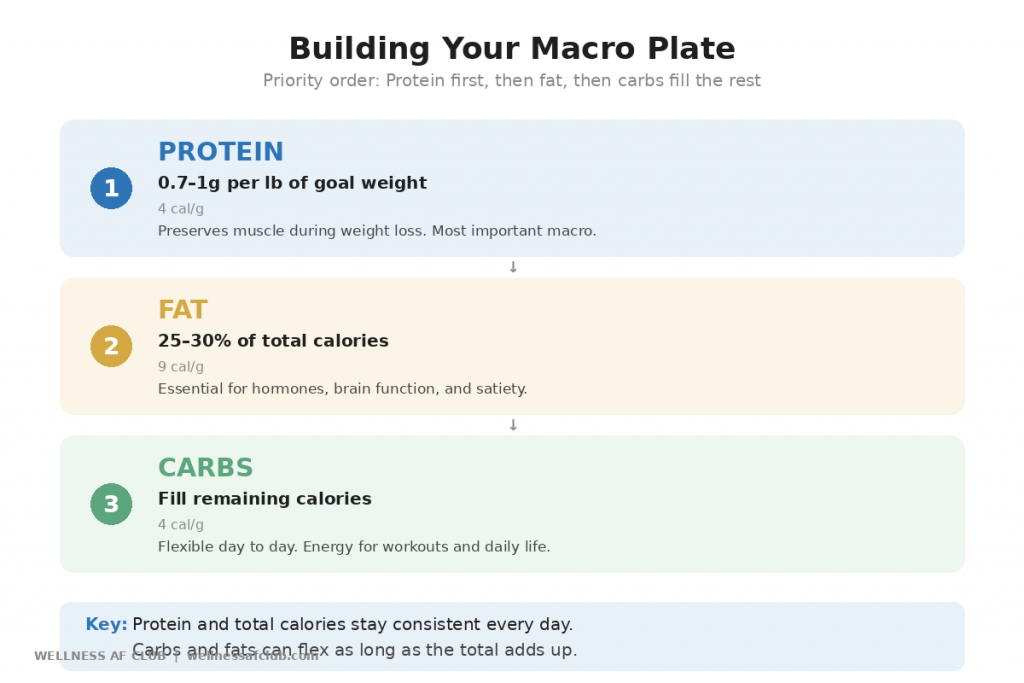
Protein comes first. Aim for 0.7 to 1 gram per pound of your goal body weight. Protein has 4 calories per gram, and it’s the single most important macro for preserving muscle during weight loss. If you lean on shakes or bars to hit it, here’s how protein powders compare with whole food. Without enough protein (and resistance training), up to 20–30% of the weight you lose can be muscle. With GLP-1 medications, that number can be even higher.
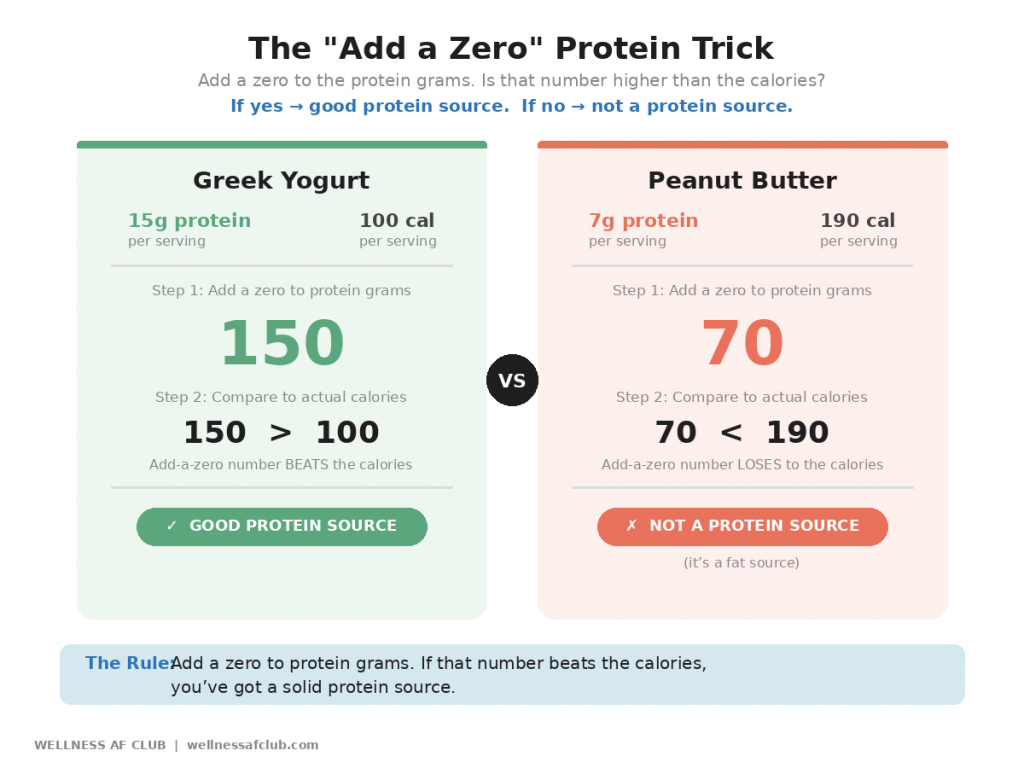
Here’s the “add a zero” trick: take the grams of protein in a serving and add a zero. That’s roughly the number of calories you’d need to eat from that food to get 100 grams of protein. A serving of chicken breast has about 25g of protein, so 250 calories to get 100g. Peanut butter has about 7g per serving, so you’d need 700 calories to reach 100g. That’s why peanut butter is a fat source, not a protein source.
Fat: set a floor of 25–30% of your total calories. Fat has 9 calories per gram and is essential for hormone production, brain function, and satiety.
Carbs: fill in whatever’s left after protein and fat. Carbs also have 4 calories per gram. The ratio between carbs and fats can flex day to day as long as your protein and total calories stay consistent.
→ Next: How to track without losing your mind, the secret calorie burner hiding in your daily routine, and your complete starting checklist.
Tracking without losing your mind
Remember that stat about people underestimating their intake by 20–50%? That’s why tracking matters, at least at first. You don’t have to do it forever, but you need to do it long enough to calibrate your intuition.
A few tracking principles that keep it sane:
- Use a digital tracker. MacroFactor is my current pick, it adapts to your actual data over time. MyFitnessPal is also solid and free.
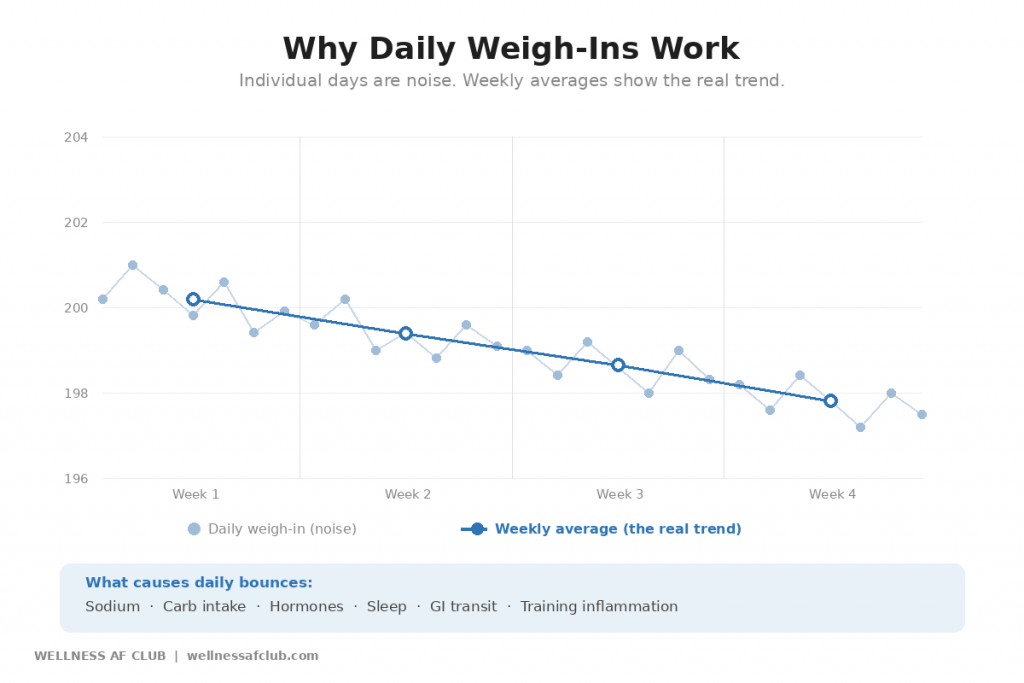
- Weigh yourself daily but only look at weekly averages. Individual days are meaningless noise. Sodium, carbs, hormones, sleep, GI transit, and training inflammation all cause weight to bounce around.
- Take body measurements monthly as a supplement to the scale. Sometimes the scale stalls but inches are still coming off.
- Habit stack: attach your new tracking habit to something you already do. Pour your coffee, then log your breakfast. Make it automatic.
The secret calorie burner: NEAT
Non-Exercise Activity Thermogenesis might be the most underappreciated factor in weight management. The difference between a low-NEAT person and a high-NEAT person can be 200 to 500 extra calories burned per day, without setting foot in a gym.
The tricky part: when you aggressively cut calories, your body subconsciously reduces your NEAT. You fidget less, you take fewer steps, you sit down more. This is one reason moderate deficits are more sustainable than extreme ones, they don’t trigger as big a compensatory response.
Simple ways to keep NEAT up: park farther away, take calls while walking, stand while you work, take the stairs. Small stuff, but it compounds.
The bottom line
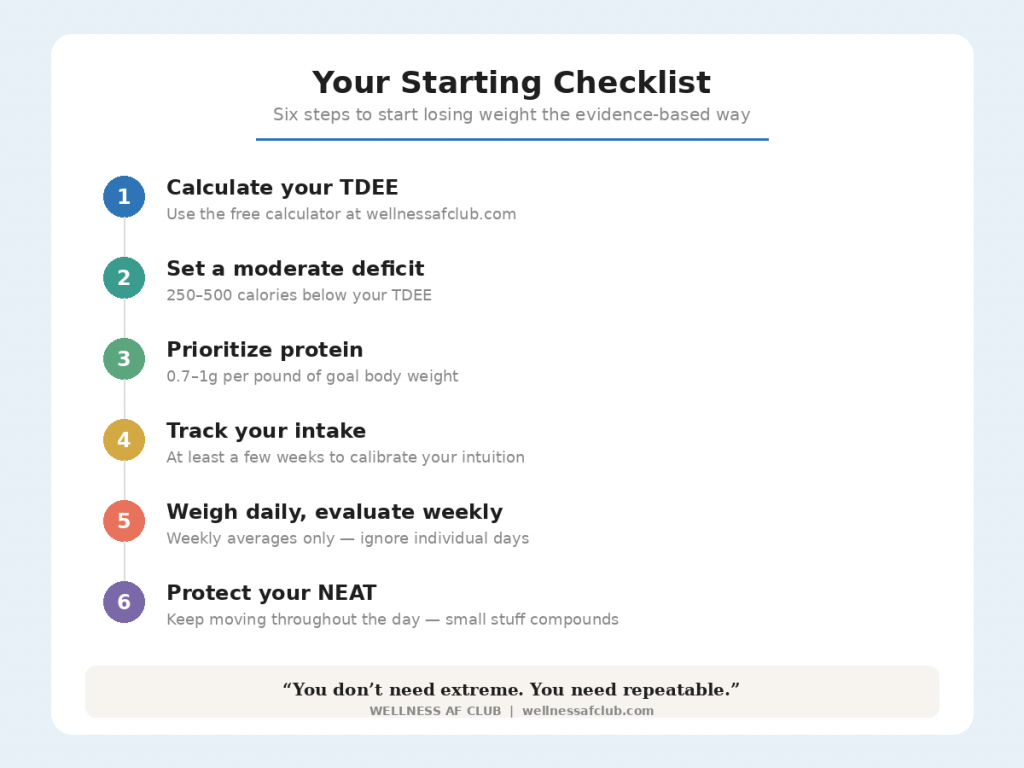
Weight loss is a math problem wrapped in biology, not a character test. Here’s your starting checklist:
- Calculate your TDEE (use the free calculator in the Wellness AF app)
- Set a moderate deficit (250–500 calories below TDEE)
- Prioritize protein (0.7–1g per pound of goal body weight)
- Track your intake for at least a few weeks to calibrate
- Weigh daily, evaluate weekly averages only
- Keep moving throughout the day, protect your NEAT
FAQ
Common questions
What is the best way to lose weight and keep it off?
A moderate calorie deficit, around 250 to 500 calories below maintenance, plus enough protein and resistance training. Crash diets lose more muscle and rebound.
How many calories should I eat to lose weight?
Estimate your maintenance (TDEE), then subtract 250 to 500 calories. That is about half a pound to a pound a week, the rate that protects your muscle.
How much protein do I need while losing weight?
Aim for 0.7 to 1 gram per pound of your goal body weight. Protein preserves muscle in a deficit and keeps you fuller.
Is it bad to weigh myself every day?
No, as long as you only judge the weekly average. Daily numbers swing from water, sodium, and hormones. The trend is what counts.
Free download
The Fat Loss Starting Kit
The whole framework on two pages: the deficit math, your protein target, the checklist, and the studies behind it. Built to keep.
Get the PDF plus a weekly, science-backed email. Leave anytime.
If this framework resonated with you, the next step is Episode 2, where we get into strength training, bone health, and why lifting heavy is the most important thing women over 40 can do for their long-term health. And if you want the weekly research breakdown delivered to your inbox, join the free Wellness AF Club newsletter.
Resources & Sources
Tools Mentioned
- Free macro/deficit calculator: the Wellness AF app
- MacroFactor app (My current pick for tracking)
- MyFitnessPal app (free option)
- Mifflin-St Jeor equation (linked in show notes)
Studies Referenced
- Pontzer et al., 2021, “Daily energy expenditure through the human life course,” Science, pubmed.ncbi.nlm.nih.gov/34385400/
- Mifflin & St Jeor, 1990, “A new predictive equation for resting energy expenditure,” American Journal of Clinical Nutrition, pubmed.ncbi.nlm.nih.gov/2305711/
- Frankenfield et al., 2005, Systematic review confirming Mifflin-St Jeor as most accurate BMR equation, pubmed.ncbi.nlm.nih.gov/15883556/
- Lichtman et al., 1992, “Discrepancy between self-reported and actual caloric intake,” New England Journal of Medicine, pubmed.ncbi.nlm.nih.gov/1454084/
- Magkos et al., 2016, “Weight loss and improvement in comorbidity at 5%, 10%, 15%, and over”, pubmed.ncbi.nlm.nih.gov/28455679/